Obviously, I've been taking a bit of break. Felt a need to re-focus. Don't want this to be my little pulpit; wanted it to be a reflection of God thru me.
Plus -- I have no time for it ...and my kids ...and schooling ...and home keeping ...etc ...etc
Thursday, May 19, 2011

Friday, April 15, 2011
When Did Wierd Become Wrong?
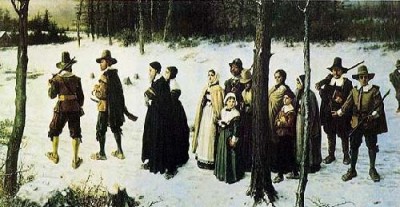 |
| George Henry Boughton "Pilgrims Going to Church" |
Lately, I have often been confronted with ...hmmm... disgust(?) with an underlying animosity from people concerning "weird" Christian. I would find this completely understandable if it were coming from non-Christians. However, it's coming from fellow Christians. It has shocked and amazed me ...until I remembered that there I was a few years ago.
About 5 or 6 years ago, I think it was, God led me to start wearing "skirts only". I simply felt that He wanted me to only wear dresses and skirts. I had trouble even figuring out why He was asking such a thing (because what did it matter what I wore?!), but guessed that it maybe was related to my need for approval. I knew that I often dressed according to the people I would be seeing. If home, relaxed, grubby; but if someone might stop by, add some nice touches. If church, nice --but don't forget and wear the same thing you wore last week or the week before. Nice style, bit of sexy thrown in. Attract attention without seeming to.
I struggled with obeying for the first year or two. I always felt wierd. In the summer it wasn't so bad, except when it was completely "inappropriate" to the situation --as in being the only one at a ball game stupid enough to come in a dress. In winter, it became so obvious. Who wears a skirt in winter in MN?? I was treated far differently. Where I formerly knew how to dress in order to be treated respectfully and/or to be admired, now I was treated with disregard or sympathy. Mostly I felt marginalized. I was just a stupid woman, giving up my identity and beauty, becoming "Amish".
Very gradually, tho, I gave up my need to be approved of for how I dressed. It became enough to have my husband's love and approval. I began to see the goodness, the beauty in dressing modestly and femininely. More importantly, I became willing to be and do whatever God desires.
What I still don't get is why it matters to anyone if the females in our family wear only skirts? Why does it matter to anyone else in the world if we choose to homeschool, to believe and teach young-earth creationism to our children, to closely guard what we read or watch, etc? Why does it matter --to them? I know it matters to God. He makes plain that He cares about these details. But why does it matter to anyone else? We are accused of abusing our children because we lovingly raise them according to our convictions?!? We are accused of hurting the witness of the church because we don't conform to culture; when did that become Biblical?!?
Here's what I see:
"The foolishness of man subverts his way, and his heart rages against the Lord." Proverbs 19:3
There's nothing new under the sun. In Eden, the serpent said, "Has God really said, 'You shall not eat of every tree of the garden?'" (Gen. 3:1) In other words, "You really think God has said not to wear certain clothes, not to go certain places, not to befriend certain people, not to do certain things???"
Genesis 3:4-5 "You shall not surely die! For God knows that in the day you eat from it your eyes will be opened, and you will be like God, knowing good & evil." Modern language: "You're so fearful of everything. All those things your so afraid of being contaminated by are really not that bad. Look at all those other people doing it and they're fine. You need to be free; free to call your own shots and not be trapped by fear of doing wrong. Be more open-minded. You know what's best for you. It's time you stepped out into the light and strength of living your own life."
So the argument comes right from the original tempter, the original temptation. However, it confuses me that we Christians can't even see the obvious examples from history. Our country was founded by wierd people who wouldn't conform to culture --dressed different, worshiped different, thought different. Peter and Paul were so abnormal and despised for it, they were put to death. It was the very wierdness of the early church that caused them to be brought before kings and rulers to explain what was different. For that matter, the entire Bible is about people who, contrary to the culture around them, followed God, looking odd the entire time. How can you say you believe the Bible when so much of it would be offensive to you if it were playing out right now??
"Do not be conformed to this world, but be transformed by the renewing of your mind..." Romans 12:2
Thursday, April 14, 2011
Free Will or Sovereign God? Part 3
And always the next question that causes us to squirm in our seats: but if God is sovereign, does He cause bad things to happen?
I certainly don't have all the answers to such a big question. But here's what I'm thinking.
God sovereignly allows some natural disasters, directing when & in what quantity. (I say this because the Bible indicates there are more toward the end of time.) God sovereignly allows some of the wicked works committed by slaves of sin. Those who are slaves to sin are under sin's rule and authority, and so would destroy themselves and the world in no time without God's intervention and restraint.
He allows evil in controlled quantities as a "kindness to lead us to repentance". If there were no darkness, we wouldn't see the light. If we could successfully live by the Tree of Knowledge of Good and Evil, we would all go happily to death and destruction. But He wants to remind us of Life. Therefore, I believe He uses the works of darkness as one of His tools to turn us back to Him.
I certainly don't have all the answers to such a big question. But here's what I'm thinking.
God sovereignly allows some natural disasters, directing when & in what quantity. (I say this because the Bible indicates there are more toward the end of time.) God sovereignly allows some of the wicked works committed by slaves of sin. Those who are slaves to sin are under sin's rule and authority, and so would destroy themselves and the world in no time without God's intervention and restraint.
He allows evil in controlled quantities as a "kindness to lead us to repentance". If there were no darkness, we wouldn't see the light. If we could successfully live by the Tree of Knowledge of Good and Evil, we would all go happily to death and destruction. But He wants to remind us of Life. Therefore, I believe He uses the works of darkness as one of His tools to turn us back to Him.
Wednesday, April 13, 2011
Free Will or Sovereign God? Part 2
God is sovereign; man's will is not.
"Free will" as it's modernly taught comes across sounding more like Judges, ie., everyone does what is right in their own eyes. This is taught as "God doesn't want a bunch of robots, so He gives us free will." We also hear it applied to wickedness, as in, "God didn't cause that bad thing; it's because we have free will." Or, "don't be so worried about obedience; that can lead to legalism. Just trust God and do what you like. He gives us free will, and He gives us grace."
God does not give us free will, setting us loose to do what we think best. He grants us the freedom to choose.
Thus, there are also only two camps of people, only two denominations, if you will.
Therefore, God is absolutely sovereign, and has sovereignly given man freedom to choose. But there is, Biblically, no such thing as free will as modernly expressed.
"Free will" as it's modernly taught comes across sounding more like Judges, ie., everyone does what is right in their own eyes. This is taught as "God doesn't want a bunch of robots, so He gives us free will." We also hear it applied to wickedness, as in, "God didn't cause that bad thing; it's because we have free will." Or, "don't be so worried about obedience; that can lead to legalism. Just trust God and do what you like. He gives us free will, and He gives us grace."
God does not give us free will, setting us loose to do what we think best. He grants us the freedom to choose.
- "And the Lord God commanded the man, saying, “From any tree of the garden you may freely eat, but of the tree of the knowledge of good and evil you shall not eat, for in the day that you eat of it you shall surely die." Genesis 2:16-17
- "The Lord said to Cain, 'Why are you angry, and why has your face fallen? If you do well, will you not be accepted? And if you do not do well, sin is crouching at the door. Its desire is for you, but you must rule over it." Genesis 4:6-7
- In Romans 6:16, Paul teaches that "you are slaves of the one whom you obey, either of sin resulting in death, or of obedience resulting in righteousness".
- 2Cor. 5:15 "and He died for all, so that they who live might no longer live for themselves, but for Him who died and rose again on their behalf."
- to live freely in God's Kingdom, abiding by His rule and authority, entrusting ourselves to His provision, moving according to His purpose;
- or to live by our own wisdom and will, dominated by self and sin, influenced by the ruler of this world, headed for death.
Thus, there are also only two camps of people, only two denominations, if you will.
- Those who are bondslaves to God, who "by perseverance in doing good" offer themselves as living sacrifices, chosen for His purpose, serving for His glory; or
- those "who are selfishly ambitious and do not obey the truth but obey unrighteousness", mastered by sin, destined for condemnation.
Therefore, God is absolutely sovereign, and has sovereignly given man freedom to choose. But there is, Biblically, no such thing as free will as modernly expressed.
Tuesday, April 12, 2011
You're All
The current cry of my heart:
Let the glory of Your name be the passion of the Church
Let the righteousness of God be a holy flame that burns
Let the saving love of Christ be the measure of our lives
We believe You're all to us.
from Chris Tomlin's song, "All to Us" (see video posted April 5)
Let the glory of Your name be the passion of the Church
Let the righteousness of God be a holy flame that burns
Let the saving love of Christ be the measure of our lives
We believe You're all to us.
from Chris Tomlin's song, "All to Us" (see video posted April 5)
Monday, April 11, 2011
Free Will or Sovereign God? Part 1
Scripture is clear: God sovereignly reigns over His creation. From Genesis to Revelation, never is God shown to be insignificant or replaceable. He is King, Ruler, God. He is Creator, Father, Owner.
Psalm 89:11 says, "The heavens are Thine, the earth also is Thine; The world and all it contains, Thou hast founded them."
In Job 38-41, God Himself makes clear that He fills and directs every bit of life on earth thru His mighty power and perfect wisdom. He's just warming up when He says, "Where were you when I laid the foundation of the earth? Tell me, if you have understanding. Who determined its measurements—surely you know! Or who stretched the line upon it? On what were its bases sunk, or who laid its cornerstone, when the morning stars sang together and all the sons of God shouted for joy?
“Or who shut in the sea with doors when it burst out from the womb, when I made clouds its garment and thick darkness its swaddling band, and prescribed limits for it and set bars and doors, and said, ‘Thus far shall you come, and no farther, and here shall your proud waves be stayed’?
“Have you commanded the morning since your days began, and caused the dawn to know its place, that it might take hold of the skirts of the earth, and the wicked be shaken out of it? It is changed like clay under the seal, and its features stand out like a garment. From the wicked their light is withheld, and their uplifted arm is broken.
“Have you entered into the springs of the sea, or walked in the recesses of the deep? Have the gates of death been revealed to you, or have you seen the gates of deep darkness? Have you comprehended the expanse of the earth? Declare, if you know all this.
“Where is the way to the dwelling of light, and where is the place of darkness, that you may take it to its territory and that you may discern the paths to its home? You know, for you were born then, and the number of your days is great!
“Have you entered the storehouses of the snow, or have you seen the storehouses of the hail, which I have reserved for the time of trouble, for the day of battle and war? What is the way to the place where the light is distributed, or where the east wind is scattered upon the earth?
“Who has cleft a channel for the torrents of rain and a way for the thunderbolt, to bring rain on a land where no man is, on the desert in which there is no man, to satisfy the waste and desolate land, and to make the ground sprout with grass?
Jesus told us in Matthew 10:29-30, "Are not two sparrows sold for a penny? And not one of them will fall to the ground apart from your Father. But even the hairs of your head are all numbered."
In Romans (8:28-30), we are taught that, "God causes all things to work together for good to those who love God, to those who are called according to His purpose. For whom He foreknew, He also predestined to become conformed to the image of His son...; and whom He predestined, He also called; and whom He called, these He also justified; and whom He justified, these He also glorified."
I could bring up examples from every book of the Bible, many, many more than I've listed here. From His sovereignty displayed at Creation to His sovereign judgment at His final revelation, there is no possible way to deny His Lordship over all He has made.
In Acts 17, Paul preaches in Athens, saying, "The God who made the world and all things in it, ...He is Lord of heaven and earth. ...He Himself gives to all life and breath and all things. ...He made from one, every nation of mankind..., having determined their appointed times, and the boundaries of their habitation, that they should seek God... though He is not far from each one of us, for in Him we live and move and have our being."
In Romans (8:28-30), we are taught that, "God causes all things to work together for good to those who love God, to those who are called according to His purpose. For whom He foreknew, He also predestined to become conformed to the image of His son...; and whom He predestined, He also called; and whom He called, these He also justified; and whom He justified, these He also glorified."
Thursday, April 7, 2011
Churchianity
It amazes me the subtle shifts modern Christian teaching makes to the Gospel in order to make it more palatable, more to their liking. I sat down recently to think about some of these.
Paul begins Romans with 3 chapters designed to leave no one a loophole. We are all wretched sinners, a living insult to the holy God who created us. He goes on to present the astounding message that God Himself made a way for us to be freed from our bondage to sin, that we might be restored to our created position as His loving and obedient children. I think most of Romans would have to be re-translated by modern standards.
For example, Romans 1:16 ("For I am not ashamed of the gospel, for it is the power of God for salvation to everyone who believes... .") would become " ...it is the love of God to save everyone who says they believe."
Romans 1:18 ("For the wrath of God is revealed from heaven against all ungodliness and unrighteousness of men, who suppress the truth in unrighteousness") is --well, wrath is ignored, so-- "the love of God is available to everyone no matter how many bad things they've done".
Those are just two examples I find right in the beginning. I could go through the entire book rewriting it to modern acceptability but that would take too long. I will just sum up what I perceive to be modern thought. (I use quotations around words not to indicate sarcasm so much as to use the words they would.)
Modern church doctrine avoids allusions to a true Kingdom with one King Who can do as He wills with His slaves and subjects. Rather it prefers a sort of Jesus-served democracy. Jesus, as a servant-leader, wants to clean up all our problem areas and help us achieve the great purposes God created in us. Simply by believing he came to save us from our failures and weaknesses and asking him to "come into your heart", we are made for now and forever a "Christian". As new Christians, we may struggle with "sin" (meaning things we feel bad about), but that's okay. That's why Jesus came: to give us grace because he loves us. We need to attend church to learn how to be blessed and fulfilled because God loves us and wants the best for us. He promises to work everything for good. Jesus is a constant help and encouragement to us on this road to successful and happy living. He is a sort of best friend, cheering us on while he prepares a place in heaven for us. However we decide to live our lives is fine; he is all for us because he loves us. Don't worry about the judgment the Bible talks about. We are now "in Christ" with our names written in his book forever. If we continue attending church and doing the best we can to be agreeable and "loving", God will certainly bring us to heaven because he loves us. If there is even such a thing as hell, it is for evil people who are disagreeable or kill lots of people or something.
This isn't just a little off from Scripture; it's the exact opposite. Scripture presents a God-centered Kingdom. He reigns. His purposes stand firm and are carried out by everything and everyone in His creation. We, by choice, are either slaves to sin and self, or slaves to God. We choose life with Him and under His dominion, or eternal death apart from Him. We live because of His great love and kindness and mercy --to grant us breath even when we choose to use it to defy Him. The love of Christ is not just a warm fuzzy idea. 2Cor 5:14 says, "the love of Christ controls us... ." Believing in His death is supposed to mean our death, as that same verse continues (and thru verse 15) "...having concluded this, that one died for all, therefore all died; and He died for all, that those who live should no longer live for themselves, but for Him who died and rose again on their behalf."
Wow! Where did we go so wrong? As believers, we are supposed to make it our ambition to be pleasing to God (2Cor 5:9). Rather, I see all around me people who call themselves Christians whose ambitions are no different from anyone else in the world.
Paul begins Romans with 3 chapters designed to leave no one a loophole. We are all wretched sinners, a living insult to the holy God who created us. He goes on to present the astounding message that God Himself made a way for us to be freed from our bondage to sin, that we might be restored to our created position as His loving and obedient children. I think most of Romans would have to be re-translated by modern standards.
For example, Romans 1:16 ("For I am not ashamed of the gospel, for it is the power of God for salvation to everyone who believes... .") would become " ...it is the love of God to save everyone who says they believe."
Romans 1:18 ("For the wrath of God is revealed from heaven against all ungodliness and unrighteousness of men, who suppress the truth in unrighteousness") is --well, wrath is ignored, so-- "the love of God is available to everyone no matter how many bad things they've done".
Those are just two examples I find right in the beginning. I could go through the entire book rewriting it to modern acceptability but that would take too long. I will just sum up what I perceive to be modern thought. (I use quotations around words not to indicate sarcasm so much as to use the words they would.)
Modern church doctrine avoids allusions to a true Kingdom with one King Who can do as He wills with His slaves and subjects. Rather it prefers a sort of Jesus-served democracy. Jesus, as a servant-leader, wants to clean up all our problem areas and help us achieve the great purposes God created in us. Simply by believing he came to save us from our failures and weaknesses and asking him to "come into your heart", we are made for now and forever a "Christian". As new Christians, we may struggle with "sin" (meaning things we feel bad about), but that's okay. That's why Jesus came: to give us grace because he loves us. We need to attend church to learn how to be blessed and fulfilled because God loves us and wants the best for us. He promises to work everything for good. Jesus is a constant help and encouragement to us on this road to successful and happy living. He is a sort of best friend, cheering us on while he prepares a place in heaven for us. However we decide to live our lives is fine; he is all for us because he loves us. Don't worry about the judgment the Bible talks about. We are now "in Christ" with our names written in his book forever. If we continue attending church and doing the best we can to be agreeable and "loving", God will certainly bring us to heaven because he loves us. If there is even such a thing as hell, it is for evil people who are disagreeable or kill lots of people or something.
This isn't just a little off from Scripture; it's the exact opposite. Scripture presents a God-centered Kingdom. He reigns. His purposes stand firm and are carried out by everything and everyone in His creation. We, by choice, are either slaves to sin and self, or slaves to God. We choose life with Him and under His dominion, or eternal death apart from Him. We live because of His great love and kindness and mercy --to grant us breath even when we choose to use it to defy Him. The love of Christ is not just a warm fuzzy idea. 2Cor 5:14 says, "the love of Christ controls us... ." Believing in His death is supposed to mean our death, as that same verse continues (and thru verse 15) "...having concluded this, that one died for all, therefore all died; and He died for all, that those who live should no longer live for themselves, but for Him who died and rose again on their behalf."
Wow! Where did we go so wrong? As believers, we are supposed to make it our ambition to be pleasing to God (2Cor 5:9). Rather, I see all around me people who call themselves Christians whose ambitions are no different from anyone else in the world.
Wednesday, April 6, 2011
Losing Religion
as reported on Fox News online in March, 2011:

A Creator and King -- Him, I can serve.
Parts of the world are literally losing their religion, according to a new study. The study conducted by the American Physical Society, finds that religion is dying out in nine countries. The findings unveiled at an APS meeting in Dallas show that religion may become extinct in Australia, Austria, the Czech Republic, Canada, Finland, Ireland, New Zealand, the Netherlands, and Switzerland.
The study, conducted by Richard Wiener of the University of Arizona and Daniel Abrams and Haley Yaple of Northwestern University, took data stretching back 100 years for those nine countries.
"In a large number of modern secular democracies, there's been a trend that folk are identifying themselves as non-affiliated with religion; in the Netherlands the number was 40 percent, and the highest number was in the Czech Republic, where the number was 60 percent."
The study also found that "Americans without affiliation comprise the only religious group growing in all 50 states."
"In 2008 those claiming no religion rose to 15 percent nationwide, with a maximum in Vermont at 34 percent," the study says.
The study concludes that religion in these societies might one day disappear.
"The model predicts that for societies in which the perceived utility of not adhering is greater than the utility of adhering, religion will be driven toward extinction."
___________________________________________________________I don't know what to say -- my reaction is so mixed to this news.
First reaction: how sad!
I've been in the Netherlands. It's tragic to see the spiritually emaciated people and the murdered churches. I believe that the religious leaders in Europe literally killed Christianity with their legalism and traditionalism. They pursued their own gain rather than God Himself. Scripture means it when it warns, "Quench not the Spirit." 1Thess. 5:19
Second reaction: good! We need to lose our "religion". Maybe then we'll find God.
Where I am, in the upper Midwest, everyone goes to church and the vast majority claim to be "Christian", tho few live it. As Scripture describes in Titus 1: "For there are many rebellious people, mere talkers and deceivers, especially those of the circumcision group. They must be silenced, because they are ruining whole households by teaching things they ought not to teach—and that for the sake of dishonest gain. Even one of their own prophets has said, “Cretans are always liars, evil brutes, lazy gluttons.”This testimony is true. Therefore, rebuke them sharply, so that they will be sound in the faith and will pay no attention to Jewish myths or to the commands of those who reject the truth. To the pure, all things are pure, but to those who are corrupted and do not believe, nothing is pure. In fact, both their minds and consciences are corrupted. They claim to know God, but by their actions they deny him. They are detestable, disobedient and unfit for doing anything good.
Really, both my reactions come from the same place, as I look at it now. The church has destroyed religion by removing the reason. When God is removed from religion, it has no life. A creed of my own design will never grab my heart; but
a God who designed everything -- Him, I can believe in.
A Creator and King -- Him, I can serve.
Emmanuel, God with us -- Him, I can love.
Tuesday, April 5, 2011
Wednesday, March 23, 2011
Thoughts on Lesson Planning
Only 6" of snow. Between husband using the blower on the driveway, and kids and I shoveling paths and barnyard and M-I-L's place, we were cleaned out by 9am. Not bad. And I l-o-v-e snow shoveling! What could be better than being out in the bright, crisp air, working hard while listening to the chickadees call?!
Tuesday night is Planning Night. Unless something happens to disrupt the schedule, kids go next door to M-I-L's house for Movie-and-Mac&Cheese Night w/Gramma, and I get 3 uninterrupted hours for school planning. Actually it rarely is a full, uninterrupted 3 hours. Sometimes M-I-L must work causing a late start. Sometimes husband is home early causing an early end. But even a couple of hours are great, and the few times when I do get the full 3 hours are so productive that I'm often ahead.
We use the Weaver Curriculum. My kids are 13 (7th grade), 9 (3rd grade), 5 (K), and almost 2. Since I refuse to go the textbook route and we're too spread out to combine in most curricula, Weaver is a great fit for us. After years of struggling to find something that would meet my qualifications, we started Weaver this summer and are really enjoying it.
One significant difference in the way we approach this curriculum is that we take 1 week per Bible lesson. The author laid it out for 2 days per Bible lesson, one to teach and one to review. This allows about 10-12 days per chapter or unit in most cases. I have found that to be insufficient time to really enjoy a unit study. The unit we're currently on, chapter 5, teaches about faithful obedience demonstrated by Abraham when he obeyed the command of God to "go to a land" He would show him. The unit topics are transportation & travel. We've done 2 weeks on the history and overview of transportation and the science behind it (ie. Newton's laws of motion and related ideas), 2 weeks on the Pilgrims (while continuing with the science studies), and we have 2 weeks coming up on flight and space travel. In addition, we're working through a book about explorers. I had wanted to talk about missionaries as well, but there just hasn't been time. We would have had to cover all of this material in 10 days following the planned schedule. To me, that makes a unit study about as exciting as a textbook. Strip all the fun out of it so you can learn in bits and pieces and get lots done really fast.
It convinces me again of my own theory on education: spiraling, or what I call the hummingbird method (sip a little here, a little there, round and round you go) works wonderfully for the skills subjects: math and language arts (and, I think, foreign language if someone would just develop that). However, content subjects: social studies and science, require time to delve in, connections to provoke interest, and projects to apply and accomplish the knowledge. Oddly enough, you see all kinds of educational developments that reverse this --trying to make skills subjects more entertaining and contents subjects like a deluge of knowledge that must be accomplished by a certain time (meaning we leave school with little to no recollection of what we learned in history).
Anyway, back to my planning. We are a few weeks away from completing chapter 5 of volume 1; I'm working on planning chapter 6. Chapter 6 teaches about famine and water beginning with the first famine in the Bible (or in the world) when Abraham went to Egypt. I'd previously outlined the 5 Bible lessons and gone through the 7th, 3rd and K objectives to select those I wanted to complete and plug them into the week where I felt they fit.
This going-through-the-objectives step is one most users seem to complain about with this curriculum. It's true that it can take a bit of time, and it's not something I want to include in the curriculum I'm hoping to write someday. On the other hand, I've found that the author included some great ideas and information in them. And reading thru them really helps to get a perspective on the unit.
So I had everything outlined and thought I'd be plugging it in to my lesson plan sheets, one of the final steps before we head into the new unit (we're about 3 weeks away). Instead I ended up making some fun revisions to my plan. I knew when I'd ended last time, I'd not been satisfied with the end result. It felt like we were jumping all over and trying to cover too many topics and too much material. In this chapter, we were supposed to cover famine, water --cycle, areas, aspects & uses, oceanography, and freshwater life. To me, each of those is a unit in itself. However, coming at it with fresh eyes, I had a fun idea dawn on me. After the week on famine, we will cover the rest of the info on water by following the water cycle. We'll begin with oceans and evaporation, proceed to clouds and condensation; then freshwater and absorption, and end with studying the aspects of water. This put it in order for me and helps to limit the areas to our focus: the part each plays in the water cycle.
Having already looked up some info on famine and hunger and bookmarking some online sites about the water cycle, I ended by plugging in my planned ideas for our first week, leaving me with a nice sense of accomplishment. Next week, I'll continue mapping out the social studies/science part of our unit on my lesson plans along with some activity ideas. After that I plug in math and language arts lessons and order library books, and we're off!
Tuesday, March 22, 2011
March in MN
 |
| Credit: Free photos from acobox.com |
And here we thought spring was coming early! Just starting to enjoy those bits of grass peeking through the snow, just adjusting to the mud tracked in, and now they're calling for a foot or better of snow in the next couple of days. That's MN for you! I love it, really. I love the change, the unpredictability. I love watching it struggle to become spring.
Monday, March 21, 2011
Hungry
A few years back our family began participating in Lenten fast. Being from a varied church background, I wasn't exposed to the idea when young. Finding it to be a beneficial exercise, we decided to make it an annual event.
My husband and I and the old-enough-to-understand children each pray for God's leading in how He would like us to fast. It's always very individually appropriate to each person. This year, tho, I've been praying for at least a month for God's leading in how He wants me to fast and not getting a conclusive answer. All I had was parts of Isaiah 58:6-7 running through my head, "Is this not the fast I choose? ...to divide your bread with the hungry...". I kept thinking, but how do I do that; we don't even know anyone hungry. (Not because we keep such exclusive circles, but rather because we live in a prosperous nation. We do help out the local food shelf. But the one time I served at the soup kitchen, I was disappointed to see that the people that came were grossly overweight. We're giving food to those who'd rather not get it for themselves while people around the world are truly starving and unable to feed their children anything but dirt!??)
And a funny little p.s. Our upcoming Weaver (curriculum) unit, set to begin in about 3 weeks, is on famine and water. God is always doing this --providing a little teacher in-service to prepare me for each unit. Makes me smile...
My husband and I and the old-enough-to-understand children each pray for God's leading in how He would like us to fast. It's always very individually appropriate to each person. This year, tho, I've been praying for at least a month for God's leading in how He wants me to fast and not getting a conclusive answer. All I had was parts of Isaiah 58:6-7 running through my head, "Is this not the fast I choose? ...to divide your bread with the hungry...". I kept thinking, but how do I do that; we don't even know anyone hungry. (Not because we keep such exclusive circles, but rather because we live in a prosperous nation. We do help out the local food shelf. But the one time I served at the soup kitchen, I was disappointed to see that the people that came were grossly overweight. We're giving food to those who'd rather not get it for themselves while people around the world are truly starving and unable to feed their children anything but dirt!??)
 |
| Credit: Free images from acobox.com |
So anyway, one morning it dawned on me that I could "divide my bread" by halving my usual portions, suffering some hunger myself, and so relate to and pray for those hungry around the world. What an eye-opener it's been! I've discovered the obvious: the hungry people around the world are ...hungry. And an awareness of the abundance and excess I participate in each day. What I call deprivation would be lush for many. How sad that it's made so difficult for us to help, that governments stand between us and those to whom we would give half (or more) of our food. So much prayer needed for these poor people. I also pray that God would somehow take what I'm not eating and feed someone needy. He is able.
And a funny little p.s. Our upcoming Weaver (curriculum) unit, set to begin in about 3 weeks, is on famine and water. God is always doing this --providing a little teacher in-service to prepare me for each unit. Makes me smile...
Wednesday, March 9, 2011
Why Is This Hope Within Me?
(from the March 8th Evening devotional in Daily Light, ESV)

I know whom I have believed, and I am convinced that He is able.
2Timothy 1:12
Able to do far more abundantly than all that we ask or think.
Ephesians 3:20
Ephesians 3:20
Able to make all grace abound to you, so that having all sufficiency in all things at all times, you may abound in every good work.
2Corinthians 9:8
2Corinthians 9:8
Able to help those who are being tempted.
Hebrews 2:18
Hebrews 2:18
Able to save to the uttermost those who draw near to God through Him, since He always lives to make intercession for them.
Hebrews 7:25
Hebrews 7:25
Able to keep you from stumbling and to present you blameless before the presence of His glory with great joy.
Jude 24
Jude 24
Able to guard until that Day what has been entrusted to me.
2Timothy 1:12
2Timothy 1:12
Who will transform our lowly body to be like His glorious body, by the power that enables Him even to subject all things to Himself.
Philippians 3:21
Philippians 3:21
"Do you believe that I am able to do this?" . . . "Yes, Lord."
"According to your faith be it done to you."
Matthew 9:28-29
Matthew 9:28-29
Tuesday, March 8, 2011
Loving Weaver

Credit: Free images from acobox.com
Do you realize God provides all the pieces for that nest, as well as the talent and understanding for the building? The bird just ...does the next thing.
Monday, March 7, 2011
Jonah

Credit: Free images from acobox.com
We are now in vol. 1, chapter 5 of our Weaver Curriculum. Jumps off from Abraham obeying God's command to go "to a land which he did not know", to pursue the theme of faithfully obeying God. The second lesson is Jonah, as an example of the opposite response, not going when God commanded. This afternoon I sort of retold the story with my Bible open on my lap (while rocking my little one) and interjecting my own "voices" into the story. Did you know Jonah didn't run away because he was scared?? I thought I did, but you read enough kids' stories and you sort of forget. The Word clearly says, Jonah clearly says, that he ran away to delay ...so that Ninevah would be wiped out before he got there!! It got me thinking, was it something like a Jew being sent to the Nazis? Had he been personally wounded by some act of the wicked Ninevites? So I started out the Bible lesson time by having each of my olders think of someone or ones that they strongly dislike and/or are afraid of. Then imagine God telling them to "Go!" They could suddenly relate to the story at a whole new level.
God recently began revelating me to a new aspect of faith by thinking of the "confidence" aspect of it. Where's your confidence? There's your faith. If you are self-confident, you trust yourself, you are confident in yourself to achieve what needs doing. This put a whole new perspective, for me, on those listed in Hebrews 11, the Hall of Faith. Their confidence was in God, so obviously they acted on that confidence. Then, this showed me a whole new side of Jonah. No wonder God pursued and disciplined him so. He knew God!! He really knew God! He knew beyond a shadow of a doubt that God would show mercy if the Ninevites repented. He knew that, so he ran, hoping to delay the inevitable. Wow!! His confidence was in God. He just also happened to be an average, weak human. No fear, tho. God had all kinds of "appointments" lined up for him. :) What a delicious story of God's sovereignty over His creation and His faithful reproofs of those whom He dearly loves!
It amazes me. I so often go into a lesson not having any idea what direction to take it, what activity to do to bring it alive. Yet God consistently directs things so that we all learn and grow. Truly, His eye is on the sparrow.
Thursday, March 3, 2011
Addition to Homeschooling Page
Just a note to inform that I've added our daily schedule to the Homeschooling Page.
The Good Shepherd

Credit: Free images from acobox.com
I'm so thankful that God is my Good Shepherd, that He "gently leads those that have young". I need Him every hour!
Wednesday, March 2, 2011
Where Are the Boundaries of Praise? --by Steve Ham
(Originally published by Steve Ham, AiG Biblical Authority Devotional, Feb. 28)

Credit: Free images from acobox.com
Credit: Free images from acobox.com
Praise the Lord from the heavens; praise Him in the heights! Praise Him, all His angels; praise Him, all His hosts! Praise Him, sun and moon; praise Him, all you stars of light! Praise Him, you heavens of heavens, and you waters above the heavens! Psalm 148:1–4
Today’s big question: where are the boundaries of praise?
All of creation praises God, and in today’s passage, we get a glimpse of the great praise from the heavens. The host of angels praise. The sun, moon, and stars praise. All aspects of the heavens—the hosts, lights, constellations, and celestial beings—praise God.
If you have ever wandered outside in the country on a clear night and looked into the sky, you know what it is like to be amazed at the vast array of lights. Seeing the Milky Way spread across the sky like a river and knowing it is filled with countless stars, many of which are multiple times bigger than the sun, is a jaw dropping experience. The earth is a seemingly insignificant speck in a galaxy within an ocean of galaxies, and God created it all. No wonder these first four verses in Psalm 148 continue to repeat the command, “Praise Him.”
The light that rules the day—Praise Him. The lesser lights that rule the night—Praise Him. The heavenly hosts—Praise Him. The angels that witnessed creation and burst out in glorious adoration at God’s limitless power— Praise Him. The words in the Psalm are not meant for us to simply look at and gain information that God is to be praised. We should catch the same vision of praise that was in the psalmist’s heart.
Today, we get to look at the very same stars, moon, and sun. We know that the holy angels have been in constant adoration since the beginning. We join them and the psalmist. Praise God.
Don’t just read but join the symphony of praise. Praise God. He is the Creator. He is the Sustainer. He is the Savior. He is the exalted one. He is above all. He rules all. He will ultimately restore all. The most distant galaxies have not reached the boundaries of His praise. Praise God. Say it, sing it, live it, and love it.
The praise of God to the glory of God is the existence of the saints, and we join with a spectacular chorus already in full voice. Not only is there no distant boundary for the praise of God, but also there is no distance in time. God is to be praised everywhere for all time.
Thursday, January 27, 2011

Wednesday, January 26, 2011
Why "Christian Stewardship" Trends Are Unbiblical
And the seed which fell among the thorns, these are the ones who have heard, and as they go on their way they are choked with worries and riches and pleasures of this life, and bring no fruit to maturity.
Luke 8:14
Many, many declared Christians are being choked into fruitlessness and immaturity of faith by worldliness. What I find more disturbing is church leadership promoting love of the world rather than love for God and the pure truth of the Word. One area that I have recently observed this is the deceiving argument for "stewardship".
 |
| Do not be anxious for your life. ...Look at the birds of the air, that they do not sow, neither do they reap, nor gather into barns, and yet your heavenly Father feeds them. ...But seek first His kingdom and His righteousness; and all these things shall be added to you. Matthew 6:25, 26, 33 |
Various Christian voices encourage me to wisely steward
- the gift of health by removing white flour, sugar and high fructose corn syrup from my family's diet, serve whole-grain breads with organic fruits &; vegetables, and if we must eat meat, make sure it's grass-fed beef, for goodness sake!
- the financial gifts God has given by living debt-free, keeping to a budget, paying cash-only, and tithing 10% (because "God rewards a cheerful giver"),
- our earthly home by recycling, saving energy, conserving water, and avoiding pesticides,
or
- the gift of my life, time and energy by good choices, simple living, and balanced activities. I should declutter, live smaller, get back to basics, smell the roses.
These things are definitely not bad in and of themselves. If simply given as good advice to follow for a long and healthy life, there's not much wrong with them. But when we make it a God-ordained responsibility, we say that to do these things should form a large part of a life devoted to pleasing God. I believe that these various areas of so-called stewardship are contrary to faith, contrary to true righteousness for the following reasons:
1. They address earthly concerns using earthly wisdom, thus setting our minds on "things on earth" rather than "things above". If then you have been raised up with Christ, keep seeking the things above, where Christ is seated at the right hand of God. Set your mind on the things above, not on the things that are on earth.
Colossians 3:1-2
If we are focusing our energy and attention on how to live well, eat right, and manage money wisely, our attention is directed almost entirely to earthly concerns. Unless God is clearly revealing His concern that we live in a certain way and, therefore, we do so out of direct obedience to Him, I believe all our "stewardship" is an abominable stench to God. It's us, working on us, to benefit us, saying it's for Him.
2. They are an assault on faithful dependence.
If we continually seek Godly wisdom from above, He will lead us in what He desires for us for that time. Sometimes (often), God's wisdom doesn't match human wisdom. We have to be willing to do and be what seems foolish, weak, or despised in order to be found in Him.
For consider your calling, brethren, that there were not many wise according to the flesh, not many mighty, not many noble; but God has chosen the foolish things of the world to shame the wise, and God has chosen the weak things of the world to shame the things which are strong.
1Corinthians 1:26-27
God often directed the prophets to live in a way that we would call unhealthy. Would we be willing to follow Him there? Would Abraham have been willing to leave everything familiar and secure for an unknown land if he'd have been following stewardship principles? Jesus Himself didn't exactly steward His finances well, infuriating Judas.
We are supposed to walk by the Spirit, not by Nourishing Traditions or Dave Ramsey.
3. They are self-serving, insulating us from hardship.
Philippians 2:4-7
Throughout Scripture we are taught to lay ourselves down, to present ourselves as living sacrifices. I can't see how this message gels with the message of stewardship at all. Paul tells us to count ourselves as dead to this life. How are we supposed to be dead and concerned with this life at the same time?
I think stewardship speaks to our desire for safety and security. "If you do x, y, and z, you will have a healthy, secure, and happy life ...unto the glory of God, of course." But Jesus taught in the Beatitudes (Matthew 5, Luke 6) that we are blessed if we are poor, grieving, hungry & thirsty, hated, ostracized. He told us that it's bad ("woe to you...") if we are rich ("for you are receiving your comfort in full"), well-fed, laughing. We are supposed to lose the world, not gain it.
Whatever things were gain to me, those things I have counted as loss for the sake of Christ. More than that, I count all things to be loss in view of the surpassing value of knowing Christ Jesus my Lord, for whom I have suffered the loss of all things, and count them but rubbish in order that I may gain Christ."
Philippians 3:7-8
4. They dilute our witness.
I will not presume to speak of anything except what Christ has accomplished through me...
Romans 15:18
We are to be known as those transformed by the life of Christ, those who love Him and speak of Him at all times. Rather, I find other Christians to be known for being debt-free or eating mostly vegetarian. Is the world coming to us to hear about the wonders of God's redemption or how to use essential oils? At the end of our life, will we be represented as radically loving God or really smart with money?
In everything commending ourselves as servants of God, in much endurance, in afflictions, in hardships, in distresses, in beatings, in imprisonments, in tumults, in labors, in sleeplessness, in hunger, in purity, in knowledge, in patience, in kindness, in the Holy Spirit, in genuine love, in the Word of truth, in the power of God; by the weapons of righteousness for the right hand and the left, by glory and dishonor, by evil report and good report; regarded as deceivers and yet true; as unknown yet well-known, as dying yet behold, we live; as punished yet not put to death, as sorrowful yet always rejoicing, as poor yet making many rich, as having nothing yet possessing all things.
2Corinthians 6:4-10
Tuesday, January 25, 2011
Monday, January 24, 2011
Bee & Boo

When my Bee was about 3 years old, she became quite serious about her desire for a baby sister. I told her she needed to pray about it, tell God how much she'd like a baby sister, and trust that He would do what was best. Apparently she needed a baby sister. God gave her our little Boo as a slightly belated-birthday present. These two peas-in-a-pod are exactly 4 years and 6 days apart.
As my dear friend keeps reminding me, God delights in every detail of our lives. Oh to be like children who delight to be delighted in.
Friday, January 21, 2011
Bug's New Room
Our growing girl received a room of her own for her 13th birthday present. She's in heaven!
 | |
| At her newly-built-by-Daddy desk |
 |
| A little more of the room... |
 |
| This dresser belonged to her Grampa's parents. What a gift!! |
 |
| Bug & Boo on her big, puffy new bed. She looooovvves it! So does little sister Boo! |
Bug says hi to her best friends, J & A, and "I wish you were here!!"
Thursday, January 20, 2011
In Everything Give Thanks
(copied excerpt from Daily Strength for Daily Needs)
Thou shalt rejoice in every good thing which the Lord thy God hath given unto thee.
-- Deuteronomy 26:11
Rejoice evermore. In everything give thanks.
--1 Thessalonians 5:16, 18

Grave on thy heart each past 'red-letter day'!
Forget not all the sunshine of the way
By which the Lord hath led thee; answered prayers,
By which the Lord hath led thee; answered prayers,
And joys unasked, strange blessings, lifted cares,
Grand promise-echoes! Thus thy life shall be
One record of His love and faithfulness to thee.
--F.R. Havergal
Gratitude consists in a watchful, minute attention to the particulars of our state, and to the multitude of God's gifts, taken one by one. It fills us with a consciousness that God loves and cares for us, even to the least event and smallest need of life. It is a blessed thought, that from our childhood God has been laying His fatherly hands upon us, and always in benediction; that even the strokes of His Hands are blessings, and among the chiefest we have ever received. When this feeling is awakened, the heart beats with a pulse of thankfulness. Every gift has its return of praise. It awakens an unceasing daily converse with our Father, --He speaking to us by the descent of blessings, we to Him by the ascent of thanksgiving. And all our whole life is thereby drawn under the light of His countenance, and is filled with a gladness, serenity, and peace which only thankful hearts can know.
--H.E. Manning
"even the strokes of His Hands are blessings" Truly ....Thank you, Father, my Lord & God, for Your many blessings, for Your rod & your staff, for "working in me to will and to act according to Your purpose."
Wednesday, January 19, 2011
Why Is the Age of the Earth an Important Issue? Part 2
To continue last week's post with answer from The New Answers Book 1 from Answers in Genesis...
7. Belief in millions of years undermines the Bible's teaching on death and on the character of God. Genesis 1 says six times that God called the creation "good," and when He finished creation on Day 6, He called everything "very good." Man and animals and birds were originally vegetarian (Gen. 1:29-30, plants are not "living creatures," as people and animals are, according to Scripture). But Adam and Eve sinned, resulting in the judgment of God on the whole creation. Instantly Adam and Eve died spiritually, and after God's curse they began to die physically. The serpent and Eve were changed physically and the ground itself was cursed (Genesis 3:14-19). The whole creation now groans in bondage to corruption, waiting for the final redemption of Christians (Romans 8:19-25) when we will see the restoration of all things (Acts 3:21; Colossians 1:20) to a state similar to the pre-Fall world, when there will be no more carnivorous behavior (Isaiah 11:6-9) and no disease, suffering, or death (Revelation 21:3-5) because there will be no more Curse (Revelation 22:3). To accept millions of years of animal death before the creation and Fall of man contradicts and destroys the Bible's teaching on death and the full redemptive work of Christ. It also makes God into a bumbling, cruel creator who uses (or can't prevent) disease, natural disasters, and extinctions to mar His creative work, without any moral cause, but still calls it all "very good."
8. The idea of millions of years did not come from the scientific facts. This idea of long ages was developed by deistic and atheistic geologists in the late eighteenth and early nineteenth centuries. These men used anti-biblical philosophical and religious assumptions to interpret the geological observations in a way that plainly contradicted the biblical account of creation, the Flood, and the age of the earth. Most church leaders and scholars quickly compromised using the gap theory, day-age view, local flood view, etc. to try to fit "deep time" into the Bible. But they did not understand the geological arguments and they did not defend their views by careful Bible study. The "deep time" idea flows out of naturalistic assumptions, not scientific observations.
9. Radiometric dating methods do not prove millions of years. Radiometric dating was not developed until the early twentieth century, by which time virtually the whole world had already accepted the millions of years (idea). For many years creation scientists have cited numerous examples in the published scientific literature of these dating methods clearly giving erroneous dates (e.g., a date of millions of years for lava flows that occurred in the past few hundred years or even decades). In recent years creationists in the RATE project have done experimental, theoretical, and field research to uncover more such evidence (e.g., diamonds and coal, which the evolutionists say are millions of years old, were dated by carbon-14 to be only thousands of years old) and to show that decay rates were orders of magnitude faster in the past, which shrinks the millions of years to thousands of years, confirming the Bible.
Conclusion
These are just some of the reasons why we believe that the Bible is giving us the true history of the world. God's Word must be the final authority on all matters about which it speaks--not just the moral and spiritual matters, but also its teachings that bear on history, archaeology, and science.
What is at stake here is the authority of Scripture, the character of God, the doctrine of death, and the very foundation of the gospel. If the early chapters of Genesis are not true literal history, then faith in the rest of the Bible is undermined, including its teaching about salvation and morality.
I think that pretty much lays out exactly why the first chapters in the Bible (and our belief in them) are significant. What I don't understand is why people who call themselves believers put more faith in scientists than in God's Word.
Tuesday, January 18, 2011
Life-long Longing
We sang this during this morning's family worship time, and it once again brought tears to my eyes. Can you imagine ...forever worshiping our great King?!
Friday, January 14, 2011
Family Game
 |
| Gramma with Bee & Boo |
Last night we had my m-i-l over for supper, and invited her to stay afterward for a game of Mexican Rummy. First hand: 2 sets; Bug(13) was out before I could even pick up my cards! Second hand: 1 set, 1 run. Continued...
3rd: 2 runs
4th: 3 sets
5th: 2 sets, 1 run -- Son(9) gloated that he was dealt a perfect hand and would be down so quick it would make our heads spin. Didn't quite happen. Couldn't get the "one card" he needed, so most were down before he went out.
6th: 2 runs, 1 set
7th: 3 runs, all different suits, must lay all cards down, no discard -- Gramma (m-i-l) won!!
Shocking thought -- do you realize how few American households were likely to be enjoying a multi-generational family game last night?? What a loss. Such a simple joy!
Thursday, January 13, 2011
Wednesday, January 12, 2011
Why Is the Age of the Earth an Important Issue? Why Make a Big Deal of It?

To answer this, I'm taking info directly from The New Answers Book 1 from Answers in Genesis, edited by Ken Ham, because it's so clearly presented there's no point in my re-doing it. All quotation of the book will be italicized. So, beginning on page 26...
...some of the reasons we think that Christians cannot accept millions of years without doing great damage to the church and her witness in the world.
1. The Bible clearly teaches that God created in six literal, 24-hour days a few thousand years ago. The Hebrew word for day in Genesis 1 is yom. In the vast majority of its uses in the Old Testament it means a literal day; and where it doesn't, the context makes this clear.
2. The context of Genesis 1 clearly shows that the days of creation were literal days. First, yom is defined the first time it is used in the Bible (Genesis 1:4-5) in its two literal senses: the light portion of the light/dark cycle and the whole light/dark cycle. Second, yom is used with "evening" and "morning." Everywhere these two words are used in the Old Testament, either together or separately and with or without yom in the context, they always mean a literal evening or morning of a literal day. Third, yom is modified with a number: one day, second day, third day, etc., which everywhere else in the Old Testament indicates literal days. Fourth, yom is defined literally in Genesis 1:14 in relation to heavenly bodies.
3. The genealogies of Genesis 5 and 11 make it clear that the creation days happened only about 6,000 years ago. It is transparent from the genealogies of Genesis 5 and 11 (which give very detailed chronological information, unlike the clearly abbreviated genealogy in Matthew 1) and other chronological information in the Bible that the Creation Week took place only about 6,000 years ago.
4. Exodus 20:9-11 blocks all attempts to fit millions of years into Genesis 1. "Six days you shall labor and do all your work, but the seventh day is a sabbath of the Lord your God; in it you shall not do any work, you or your son or your daughter, your male or your female servant or your cattle or your sojourner who stays with you. For in six days the Lord made the heavens and the earth, the sea and all that is in them, and rested on the seventh day; therfore the Lord blessed the sabbath day and made it holy" (Exodus 20:9-11)
This passage gives the reason for God's command to Israel to work six days and then take a sabbath rest. Yom is used in both parts of the commandment. If God meant that the Jews were to work six days because He created over six long periods of time, He could have said that using one of three indefinite Hebrew time words. He chose the only word that means a literal day, and the Jews understood it literally (until the idea of millions of years developed in the early nineteenth century). For this reason, the day-age view or framework hypothesis must be rejected. The gap theory or any other attempt to put millions of years before the six days are also false because God says that in six days He made the heave and the earth and the sea and all that is in them. So He made everything in those six literal days and nothing before the first day.5. Noah's Flood washes away millions of years. The evidence in Genesis 6-9 for a global catastrophic flood is overwhelming. For example, the Flood was intended to destroy not only all sinful people but also all land animals and birds and the surface of the earth, which only a global flood could accomplish. The Ark's purpose was to save two of every kind of land animal and bird (and seven of some) to repopulate the earth after the Flood. The Ark was totally unnecessary if the Flood was only local. People, animals, and birds could have migrated out of the flood zone before it occurred, or the zone could have been populated from creatures outside the area after the Flood. The catastrophic nature of the Flood is seen in the nonstop rain for at least 40 days, which would have produced massive erosion, mud slides, hurricanes, etc. The Hebrew words translated "the fountains of the great deep burst open" (Genesis 7:11) clearly point to tectonic rupturing of the earth's surface in many places for 150 days, resulting in volcanoes, earthquakes, and tsunamis. Noah's Flood would produce exactly the kind of complex geological record we see worldwide today: thousands of feet of sediments clearly deposited by water and later hardened into rock and containing billions of fossils. If the year-long Flood is responsible for most of the rock layers and fossils, then those rocks and fossils cannot represent the history of the earth over millions of years, as evolutionists claim.
"Okay, so you've addressed literal translation of Genesis, but you still haven't answered why this is sooooo important?" Next week I'll complete posting the AiG answer to this question which addresses Jesus' position, the Bible's authority, and faulty science. And if you want more information on this, read The New Answers Book 1. They go in to much more detail in answering these questions and others than I have time for here.
Subscribe to:
Comments (Atom)